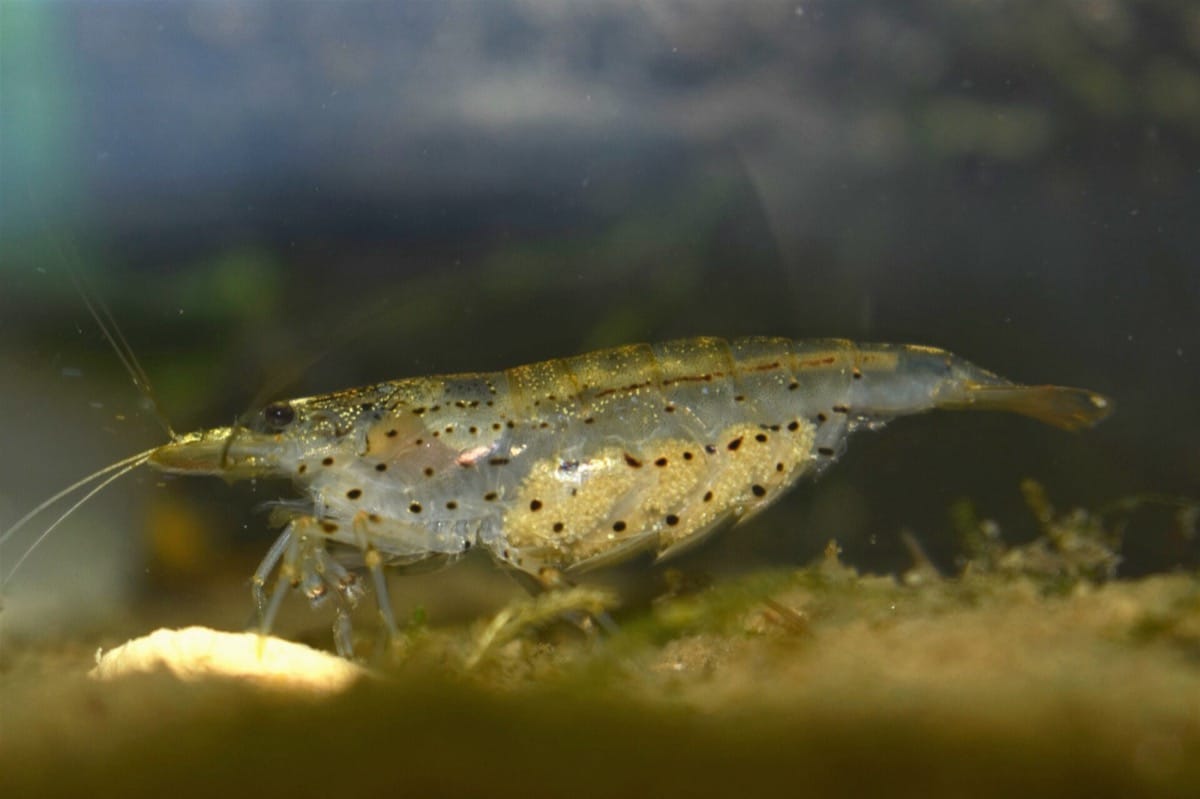
An Amano shrimp is an animal to feed, not a substitute for aquarium maintenance. Choose a mature planted setup with grazing surfaces and hiding places, then check that every shrimp receives food even after the visible algae declines.
- Temperature15-28 C published range
- pH6.0-8.0
- Tank planning40 L or more for a small group; editorial starting plan
- DifficultyIntermediate
| Grazing space | Established plants, wood and other accessible surfaces |
|---|---|
| Meals | Offer shrimp food at several reachable spots |
| Reproduction | Adult freshwater care is not a larval rearing protocol |
Care parameters and their limits
- Temperature: 15-28 C published range
- Fishkeeper lists a broad aquarium range, not a demonstrated optimum at every point. Choose stable conditions compatible with the supplier water and the other inhabitants; do not use endpoints as treatment targets. Fishkeeper: Amano shrimp - Caridina multidentata
- pH: 6.0-8.0
- Fishkeeper broad acclimatisation range, not a reason to make abrupt chemical adjustments. Fishkeeper: Amano shrimp - Caridina multidentata
- General hardness: 6-18 dGH
- Fishkeeper lists dH 6-18 degrees, interpreted here as general hardness. It does not supply a separate KH target or demonstrate that all mineral compositions are equivalent. Fishkeeper: Amano shrimp - Caridina multidentata
- Adult size: Up to about 5 cm
- Fishkeeper maximum size; females are generally larger. The source does not define a length measurement convention. Fishkeeper: Amano shrimp - Caridina multidentata
- Tank planning: 40 L or more for a small group; editorial starting plan
- Editorial provision for stable water, multiple feeding surfaces and moulting cover. Fishkeeper supports group keeping and a furnished aquarium but gives no numeric minimum. This is not a tested threshold or a community stocking allowance. Fishkeeper: Amano shrimp - Caridina multidentata
- Lifespan: No universal captive lifespan stated
- The consulted husbandry account does not establish a reliable survival interval; the larval study does not measure adult captive longevity. Fishkeeper: Amano shrimp - Caridina multidentataCrustacean Research (2021): Larval performance of three amphidromous shrimp species in the genus Caridina under different temperature and salinity conditions
- Diet: Omnivore; grazing plus deliberately supplied shrimp food
- Fishkeeper recommends small pellets and algae wafers in addition to algae, and lists other prepared and frozen foods. Fishkeeper: Amano shrimp - Caridina multidentata
- Social planning: Small group; 5-6 is an editorial starting example
- Fishkeeper recommends groups but supplies no minimum count. The example is not a measured social threshold; food, cover and the aquarium load still constrain numbers. Fishkeeper: Amano shrimp - Caridina multidentata
Build grazing space before buying the grazers
Caridina multidentata, formerly sold as Caridina japonica, reaches about 5 cm in the Fishkeeper species account. Plants, wood and other established surfaces give it places to forage; sheltered gaps also let a shrimp withdraw after moulting. A freshly cycled but bare aquarium can process some waste without offering much natural grazing. Do not stock it as though clear water proves the food supply is ready.
Our starting example is a small group of five or six in 40 litres or more. These are editorial planning choices, not experimental minimums: Fishkeeper recommends group keeping but does not specify a number or tank volume. Use a planted base with several accessible feeding and hiding areas rather than relying on height alone. More shrimp require more usable surfaces and food, not simply another few litres on a calculator. A fish community adds its own space and filtration requirements.
Fishkeeper publishes broad ranges of 15-28 C, pH 6.0-8.0 and hardness 6-18 degrees. They describe adaptable aquarium conditions, not a reason to move between the endpoints. Ask which water the shrimp are being held in and plan a careful transition. Keep an established filter running, measure ammonia and nitrite, and match treated replacement water appropriately. Do not preserve deteriorating water merely to avoid change; adjust maintenance to test results and accumulated waste.
Algae grazing is not a complete feeding plan
Visible algae can decrease while the shrimp still need food. Fishkeeper recommends small pellets and algae wafers alongside grazing, and describes shrimp taking a piece away to eat under cover. Supply an appropriate prepared shrimp food rather than assuming fish leftovers will reach them. Follow its feeding guidance, observe intake and remove uneaten portions.
Several small feeding spots are more useful than one large piece monopolised by the first shrimp to find it. Check both directions of competition: fish may intercept food before it reaches the bottom, while an Amano may carry a portion away from a smaller grazer. Food disappearing is not proof that every animal has eaten. Do not respond by leaving a permanent pile of food under the plants.
Keep predatory or aggressive fish out of the plan. Even a fish described as peaceful may investigate a shrimp, especially when it is exposed after moulting. Size and overlapping temperature ranges alone do not establish compatibility. Provide retreats inaccessible to the proposed fish, observe interactions and keep a suitable separate setup available; persistent picking or injuries mean the combination needs changing. An invertebrate-focused aquarium is the simpler option when protecting the shrimp is the priority.
Eggs in freshwater do not mean a freshwater colony
Females can carry eggs and release larvae while living in freshwater. The important distinction is what happens next: the larvae are not miniature benthic shrimp ready to grow alongside the adults. A 2021 study of three amphidromous Caridina species documents the saline larval-development phase of C. multidentata. This is why adult freshwater keeping does not normally produce a self-sustaining colony.
Keep the adult display freshwater. A female carrying eggs is not a reason to salt the community aquarium. Raising larvae is a separate specialist project involving suitable saline water and larval food; adult water ranges in the parameter panel are not larval culture instructions. If your goal is simply to maintain a small group, plan to care for those animals rather than expecting every brood to replace losses.
A shed shell is not a diagnosis; fish medicines are not shrimp medicines
An empty, recognisable shell can be a normal moult, and a recently moulted shrimp may hide while its new shell hardens, as described in Fishkeeper's care notes. A living shrimp struggling on its side, unable to move normally or trapped in a moult is a different observation. It does not identify a mineral deficiency or infection by itself. Do not pull off the shell or add minerals blindly.
Check temperature, ammonia, nitrite, aeration and recent water or chemical changes. Repeated losses, failed moults, persistent abnormal movement or rapid deterioration need prompt advice from an aquatic veterinarian or qualified aquatic-health professional with invertebrate experience. Record actual water results and every product used. Stop an improvised intervention if distress worsens; do not wait for a fixed observation period when several animals are affected.
UF/IFAS warns that copper treatment concentrations can kill most invertebrates; its marine treatment calculations must not be applied to this freshwater shrimp. Do not dose a shrimp aquarium with a fish medicine, salt or heat treatment on the assumption that a reduced dose is safe. Check the exact product label and obtain explicit shrimp-compatibility advice from the manufacturer and treating professional before any treatment. A copper-free label alone does not establish that every other ingredient is suitable.
New to the words? See the aquarium glossary.
Sources and research notes
The tank and group examples are editorial provisions, not published biological minimums. The larval study does not set adult water conditions. No population-based captive lifespan is asserted, and the unavailable Seriously Fish species link is not used as evidence.
Content reviewed 2026-10-14. Tankwise Editorial provides husbandry information, not veterinary diagnosis.
- Fishkeeper: Amano shrimp - Caridina multidentata
Identity, size, published water ranges, group keeping, supplemental food, predation, moulting and medication compatibility. Commercial specialist husbandry guidance, not controlled minimum-tank or social-group research. Numeric group and volume examples are editorial. Broad temperature limits are not a demonstrated optimum; detailed breeding timings are not adopted. Accessed 2026-10-14.
- Crustacean Research (2021): Larval performance of three amphidromous shrimp species in the genus Caridina under different temperature and salinity conditions
Experimental evidence for saline larval development in Caridina multidentata, distinct from freshwater adult keeping. Public abstract consulted. Experimental larval temperature and salinity combinations are not adult aquarium targets or a complete breeding protocol; adult lifespan was not studied. Accessed 2026-10-14.
- UF/IFAS FA165: Use of copper in marine aquaculture and aquarium systems
Copper toxicity to invertebrates and the need to consider non-target animals and seek specialist advice. Marine-system guidance used only for the toxicity warning. No marine doses, removal thresholds or treatment schedules are transferred to freshwater shrimp. Accessed 2026-10-14.