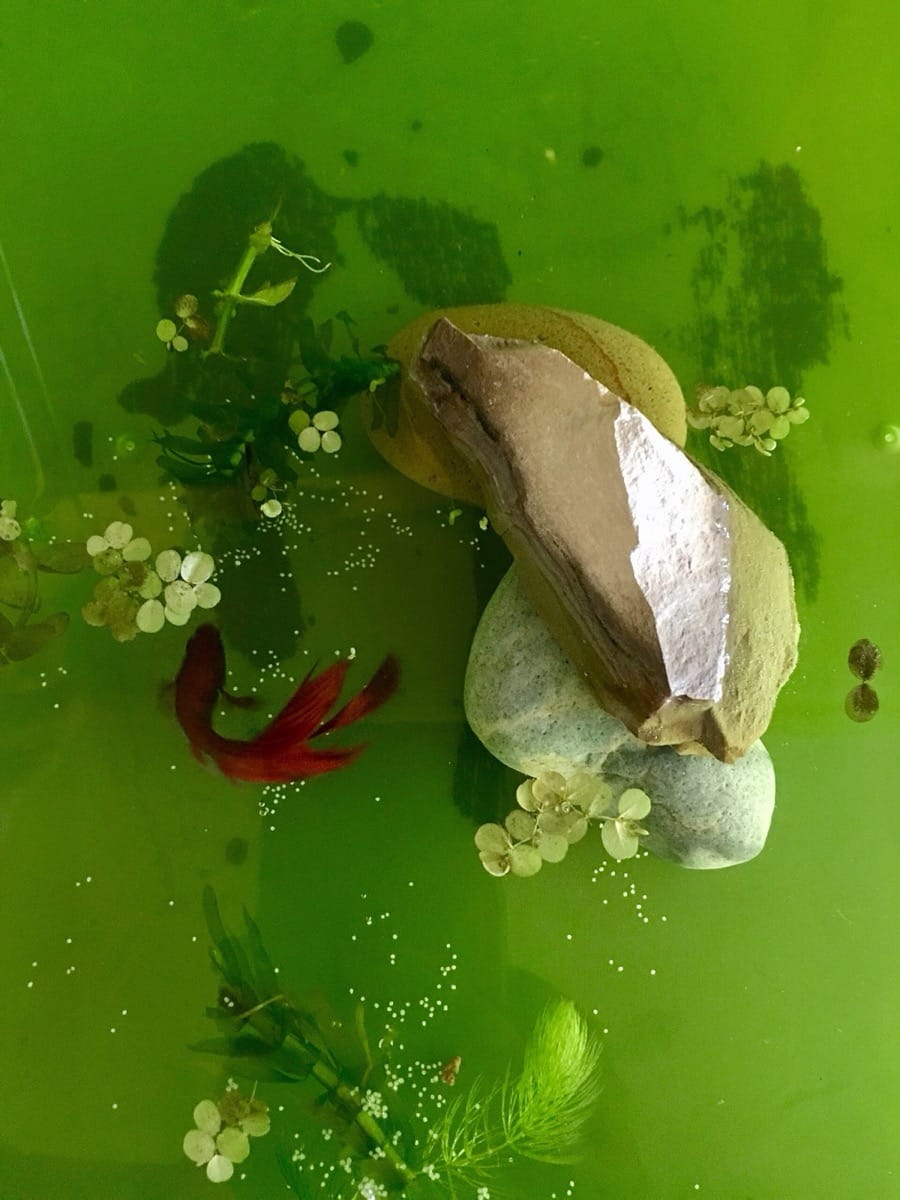
Plan around one betta: gentle filtration, clear access to surface air, and sheltered resting places. Long fins and territorial behaviour matter more than a list of possible tankmates.
- Temperature24-26 C
- pH6.5-7.5
- Tank planning40 L+; 45 x 30 cm base
- DifficultyBeginner with a prepared single-fish tank
| First decision | Keep one betta, not a pair or a sorority |
|---|---|
| Feeding check | Watch it take appropriately sized food |
| Layout check | Easy surface access without fighting the current |
Care parameters and their limits
- Temperature: 24-26 C
- RSPCA routine-care recommendation; narrower than the 22-30 C reference range in Seriously Fish. Not a treatment temperature. RSPCA: How should I care for my Siamese fighting fish?Seriously Fish: Betta splendens
- pH: 6.5-7.5
- RSPCA recommendation for pet bettas. Wild relatives and ornamental strains are not interchangeable. RSPCA: How should I care for my Siamese fighting fish?
- General hardness: 1-15 dGH
- Broad husbandry reference from Seriously Fish, not a reason to move an established fish between the extremes. Seriously Fish: Betta splendens
- Adult size: Up to 7 cm standard length
- Reported maximum standard length excludes the tail fin; ornamental fin spread needs additional clearance. Seriously Fish: Betta splendens
- Tank planning: 40 L+; 45 x 30 cm base
- Tankwise new-tank planning recommendation for one fish: SF supplies the base dimensions; 40 L is editorial headroom, not a proven biological minimum. RSPCA recommends ideally 20 L or more. Seriously Fish: Betta splendensRSPCA: How should I care for my Siamese fighting fish?
- Lifespan: No universal estimate supplied
- The consulted care references do not establish a lifespan expectation across ornamental strains and purchase ages. RSPCA: How should I care for my Siamese fighting fish?Seriously Fish: Betta splendens
- Diet: Carnivore; betta food plus small invertebrates
- Specialist pellets or granules with suitable frozen foods; portions depend on the product and actual intake, not a fixed pellet count. RSPCA: How should I care for my Siamese fighting fish?Seriously Fish: Betta splendens
- Social plan: One betta
- Beginner default for ornamental fish. Never house two males together; a breeding pair is not a permanent community arrangement. RSPCA: How should I care for my Siamese fighting fish?Seriously Fish: Betta splendens
A resting place is part of the swimming space
A long-finned betta should be able to cross the tank, reach air and pause without being pushed around by the filter. Arrange broad leaves or smooth resting surfaces near the top, keep an unobstructed route to the surface, and use a lid with an air space beneath it. Air breathing does not remove the need for clean, oxygenated water. RSPCA's betta guidance connects these resting sites, gentle flow and surface access to the fish's needs.
Check decorations by touch before installation: long fins can snag on rough edges. Plant cover should give the fish a retreat without filling every swimming route. Watch the actual fish after adjusting the outlet; constant effort to hold position means the layout or flow still needs attention. Do not use a mirror as permanent decoration.
Choose a footprint, not a bowl label
For a new setup, Tankwise recommends 40 L or more with at least a 45 x 30 cm base for one fish. The footprint comes from Seriously Fish's species profile; the volume is our planning margin for planting, filtration and maintenance. RSPCA instead describes 20 L or more as ideal. These are husbandry recommendations, not experimental thresholds at which a fish suddenly becomes safe or unsafe. A tall narrow vessel does not provide the same usable layout as a wider tank of equal volume.
Use a mature biological filter and a controlled heater checked with a separate thermometer. The 24-26 C and pH 6.5-7.5 planning values follow RSPCA, rather than treating the wider SF reference range as a target to cycle through. Ask about the water in which the fish was kept before changing your setup. For a settled tank, RSPCA suggests weekly partial changes of 10-25%; use tests and waste accumulation to judge whether that starting routine is sufficient, and condition replacement water according to its product label.
Solitary does not mean neglected
A betta does not need another betta as company. Two males must not share a tank, and keeping a male with a female is a specialist breeding arrangement, not a community solution. Female groups also bring aggression risks; they are not the default recommended here. The species profile recommends keeping ornamental fish alone in most cases.
If an experienced keeper attempts a mixed aquarium, matching temperature and water chemistry is only the first check. Long fins invite nipping, colourful trailing fins can invite attacks, and a betta may eat small shrimp. A larger shared tank and a ready, suitable separate aquarium are essential contingencies, not guarantees. End the combination if either fish is being chased away from food or shelter; do not wait for torn fins to prove incompatibility.
Feed the fish you can see
Offer a suitable betta pellet or granule, with small frozen invertebrates for variety. RSPCA recommends specialised food and warns about overfeeding. Pellet sizes vary, so a universal count is misleading. Add a small portion, watch it being swallowed, and remove leftovers. Keep any companions from intercepting the entire portion. A routine fasting day is not a substitute for matching food to appetite and body condition.
Fin damage and unusual breathing need assessment
A split fin can follow physical damage or aggression; a discoloured or receding edge does not identify a pathogen. Surface air-taking is normal for a betta, but struggling to reach air, continuous laboured breathing, loss of balance, progressive wounds or food refusal need prompt assessment by an aquatic veterinarian or qualified fish-health professional.
Record temperature, ammonia, nitrite, pH, recent additions and photographs; check the heater, filter and any harassment while arranging help. Merck emphasises water conditions, history and diagnostic testing, not diagnosis from appearance alone. Do not wait a fixed week for worsening damage. Do not add salt, raise the temperature as treatment, or combine medicines on the basis of a photograph. Any treatment must fit the diagnosis and product label, including plants, invertebrates and filtration; stop improvised treatment and seek urgent advice if breathing or balance deteriorates.
New to the words? See the aquarium glossary.
Sources and research notes
Routine temperature and pH follow RSPCA; the footprint and GH reference follow Seriously Fish. The larger volume is a Tankwise planning choice. No common lifespan is asserted across ornamental strains.
Content reviewed 2026-10-14. Tankwise Editorial provides husbandry information, not veterinary diagnosis.
- RSPCA: How should I care for my Siamese fighting fish?
24-26 C, pH 6.5-7.5, tank-volume advice, single-male housing, gentle flow, air access, smooth decor, diet and partial maintenance. Pet-care guidance authored by an aquatic veterinarian; not a trial of minimum volumes. Its maintenance routine needs adjustment to actual water tests. Accessed 2026-10-14.
- Seriously Fish: Betta splendens
45 x 30 cm footprint, 7 cm standard length, 1-15 dGH, broader temperature/pH ranges, feeding and territorial behaviour. Specialist secondary husbandry profile with affiliate links. Broad ranges and breeding sections are not universal domestic-care targets; no reliable general lifespan supplied. Accessed 2026-10-14.
- Merck Veterinary Manual: Management of Aquarium Fish
History, water-quality assessment, professional diagnostic testing and the risks of medication without a diagnosis. Veterinary reference, not a species-specific home-treatment protocol. No drug doses are reproduced here. Accessed 2026-10-14.