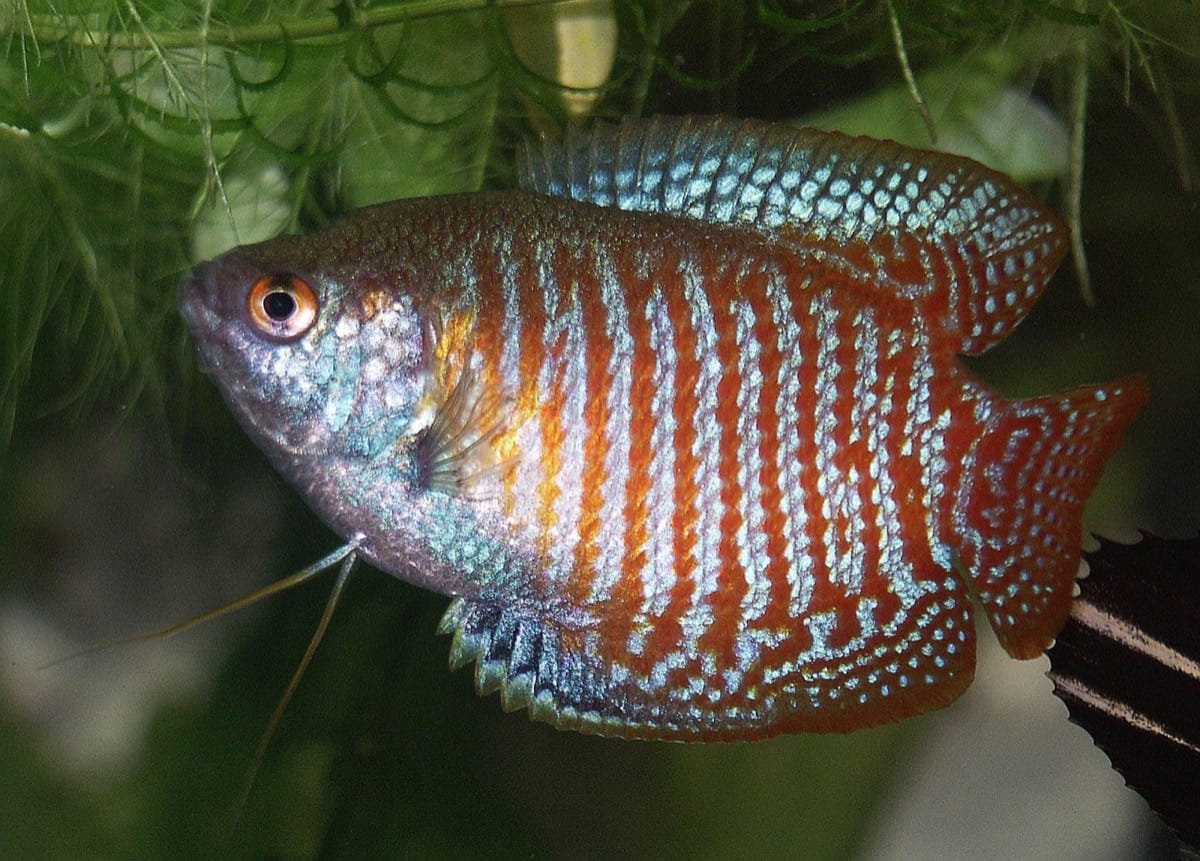
Small does not mean non-territorial. A dwarf gourami needs quiet cover, clear access to the surface and a feeding place it can use without being crowded; adding a second gourami is not an automatic improvement.
- Temperature22-27 C
- pH6.0-7.5
- Tank planning60 L or more; at least 60 x 30 cm base for one
- DifficultyIntermediate
| Surface | Leave air access between areas of floating cover |
|---|---|
| Company | Avoid competing labyrinth fish in a small setup |
| Feeding | Confirm that the gourami, not just faster fish, eats |
Care parameters and their limits
- Temperature: 22-27 C
- Seriously Fish captive husbandry range; not a treatment recommendation. Seriously Fish: Trichogaster lalius
- pH: 6.0-7.5
- Seriously Fish range for adaptable captive-bred fish; natural soft-water habitats do not require every aquarium to copy an extreme. Seriously Fish: Trichogaster lalius
- General hardness: 2-18 dGH
- Seriously Fish husbandry range. Confirm the supplier water before planning a change, rather than assuming equal tolerance of abrupt shifts. Seriously Fish: Trichogaster lalius
- Adult size: Up to 8.8 cm standard length
- Published maximum of 88 mm SL; excludes the tail fin and is not a mean adult size. Seriously Fish: Trichogaster lalius
- Tank planning: 60 L or more; at least 60 x 30 cm base for one
- Conservative editorial starting plan. Seriously Fish describes a 60 x 30 cm base, approximately 56 L aquarium as just sufficient for a carefully arranged pair, while warning of harassment. We do not extend that into a community stocking allowance. Seriously Fish: Trichogaster lalius
- Lifespan: No universal captive lifespan stated
- The consulted species account does not establish a reliable captive survival interval; neither retail-health anecdotes nor another gourami species supply one. Seriously Fish: Trichogaster lalius
- Diet: Omnivore; small complete foods with suitable frozen supplements
- Seriously Fish describes prepared food as a staple, supplemented with small live or frozen foods. Seriously Fish: Trichogaster lalius
- Social planning: One as the conservative starting plan; not a shoaling fish
- Editorial choice based on documented male territoriality and possible female harassment. Pairs can be kept with appropriate space, cover and separation options; groups are not a default. Seriously Fish: Trichogaster lalius
Make a quiet territory, not an empty small tank
Trichogaster lalius comes from slow, vegetated environments. Seriously Fish recommends shade, hiding places and low turbulence. An open box with a single ornament does not provide the same usable territory as a planted aquarium of the same volume. Arrange vegetation so the fish can withdraw from view without losing access to food or the surface.
Our starting plan is at least 60 litres with a base of at least 60 x 30 cm for one dwarf gourami. This is a conservative editorial plan, not a measured biological minimum. The source describes a similarly sized, carefully arranged tank as only just sufficient for a pair, and also warns that males can harass females. Extra litres in a tall, narrow tank do not replace horizontal separation or cover. A community requires a new assessment of every inhabitant's space, not subtraction from a generic stocking calculator.
The published 22-27 C, pH 6.0-7.5 and GH 2-18 dGH ranges concern captive care; they are not instructions to swing the water between limits. Keep filtration running without making the entire surface turbulent. As a labyrinth fish, the gourami takes atmospheric air: leave accessible surface gaps among floating plants. Air breathing does not remove its need for suitable water quality.
One gourami is a plan; two need a reason
A dwarf gourami is not a schooling fish that must be purchased as a group. We use one as the lower-conflict starting arrangement. The species account warns against multiple males in modest aquaria and notes that even a male-female pair can have problems. Do not assume two colourful shop fish are a compatible pair, or add a female simply to absorb a male's attention.
Other labyrinth fish, including bettas, can provoke territorial conflict in a small setup. Large, fast or boisterous fish create a different problem: they can intimidate the gourami or take its food. Choose any community partners by adult size, water needs, activity and feeding behaviour, not by a "peaceful" label alone. Small animals are not automatically safe merely because the gourami is small.
The honey gourami is a different species to research as an alternative, not a second centrepiece to add automatically. If keeping a pair or community, provide separate retreats and have another suitable, established space available. Repeated chasing, injury, permanent hiding or exclusion from food calls for separation and reassessment, not waiting for a fixed observation period.
Feed the fish that hangs back
A small complete flake or pellet can be the staple, with suitably sized frozen foods for variety, consistent with the species diet account. Deliver food where the gourami is comfortable rather than only into the busiest part of the aquarium. Watch it take and swallow food; a community meal disappearing quickly may mean it received none.
Adjust the portion to the food instructions, the fish's intake and remaining waste. If faster companions intercept everything, change where food is delivered or reconsider the companions before increasing the whole tank's ration. Remove uneaten food and check water tests when intake changes. A quieter feeding spot can solve competition, but it cannot explain every loss of appetite.
Viral risk deserves testing, not a visual diagnosis
Dwarf gouramis are among fish affected by megalocytiviruses. That does not mean every sick dwarf gourami has a virus, nor that a healthy-looking fish is proven free of infection. UF/IFAS explains that lethargy, darkening, swelling, appetite loss and abnormal swimming are nonspecific; confirmation requires specialist tests such as histopathology or PCR. The publication does not establish the current infection rate in your retailer's stock.
Ask about the source and losses in the sales system before buying. Keep new arrivals in a separate suitable system with dedicated equipment, and discuss testing and quarantine with a fish-health professional; an uneventful observation period is not a guarantee. If illness or deaths occur, stop transfers and equipment sharing between systems, record water quality and contact an aquatic veterinarian or qualified fish-health professional promptly. Severe breathing difficulty, loss of balance or rapid deterioration is urgent.
UF/IFAS reports no effective treatment for megalocytivirus infection. Do not turn that into a home diagnosis or an instruction to destroy fish without professional assessment. Do not raise the temperature, add salt or combine medicines as a trial cure. Other causes may require different treatment; any advised product must be checked against its exact label and the inhabitants, and an improvised intervention that worsens distress must stop while professional help is obtained.
New to the words? See the aquarium glossary.
Sources and research notes
Water ranges are captive-care guidance. The single-fish tank plan is editorial risk reduction, not a claim that pairs are impossible. No universal lifespan or current retail virus prevalence is asserted.
Content reviewed 2026-10-14. Tankwise Editorial provides husbandry information, not veterinary diagnosis.
- Seriously Fish: Trichogaster lalius
Identity, standard length, captive water ranges, cover, flow, air breathing, diet and territorial/feeding conflicts. Secondary husbandry account with commercial links. The tank plan here is explicitly more conservative than its conditional pair recommendation. Its historical virus prevalence claim is not used; it supplies no reliable lifespan dataset. Accessed 2026-10-14.
- UF/IFAS FA182: Megalocytivirus infections in fish, with emphasis on ornamental species
Susceptibility, nonspecific signs, specialist diagnosis, waterborne transmission, clinically healthy positive fish and lack of effective treatment. Multi-species extension guidance, not a current retail prevalence survey or a diagnosis. Facility depopulation and equipment disinfection protocols are not converted into home-care instructions. Accessed 2026-10-14.