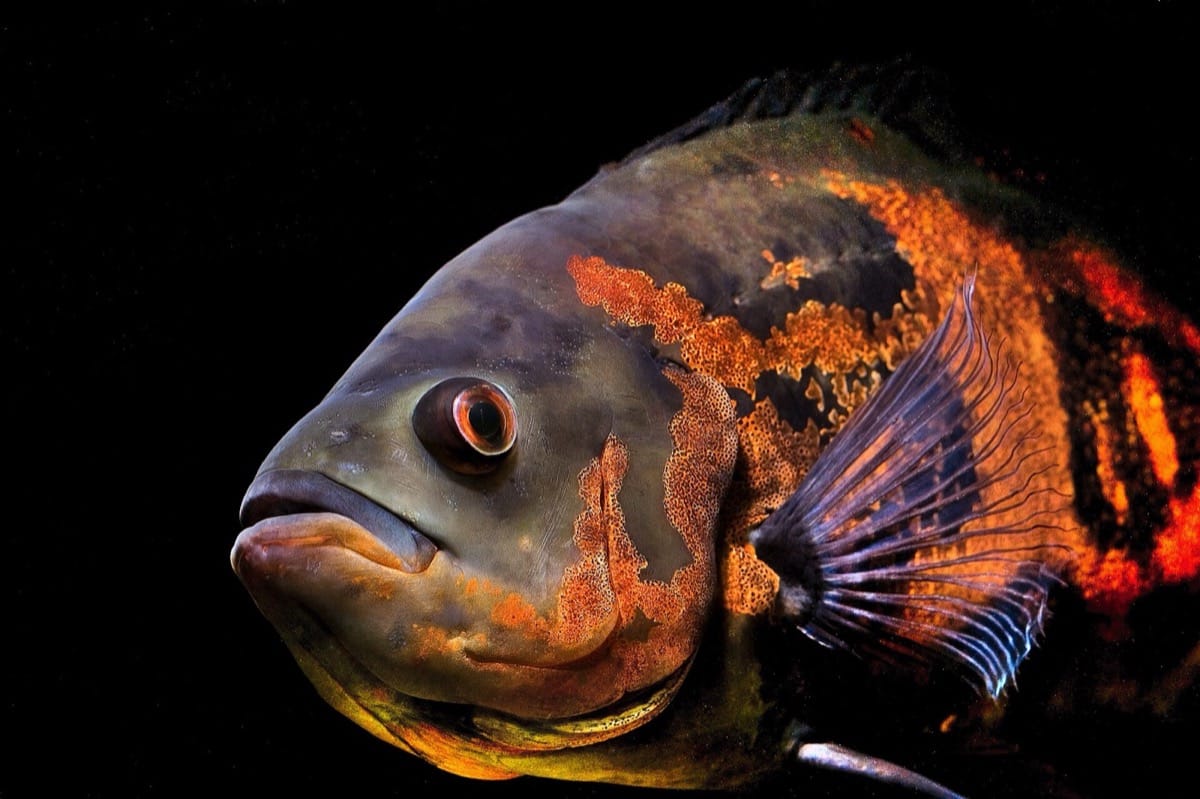
An Oscar is an adult-space decision made while the fish is still small. Plan a large, serviceable aquarium for one adult before considering companions; a juvenile community arrangement does not establish long-term compatibility.
- Temperature20-28 C
- pH6.0-7.5
- Tank planning150 x 60 cm base for one adult; larger preferred
- DifficultyIntermediate
| Before purchase | Have the adult tank and maintenance access ready |
|---|---|
| Equipment | Protect heaters and secure movable decor |
| Food | Complete pellets, not a routine of live feeder fish |
Care parameters and their limits
- Temperature: 20-28 C
- Seriously Fish husbandry range, not a prescription to use either endpoint or a treatment temperature. Seriously Fish: Astronotus ocellatus
- pH: 6.0-7.5
- Seriously Fish recommendation for captive-bred stock; wild-origin fish may need origin-specific conditions. Seriously Fish: Astronotus ocellatus
- General hardness: 5-20 dGH
- Published husbandry range, not evidence that rapid changes across the range are harmless. Seriously Fish: Astronotus ocellatus
- Adult size: Up to 35 cm standard length
- Seriously Fish maximum size. Standard length excludes the tail fin and is not the size every individual reaches. Seriously Fish: Astronotus ocellatus
- Tank planning: 150 x 60 cm base for one adult; larger preferred
- Seriously Fish describes this base as just sufficient for one adult. A 150 x 60 x 60 cm box is 540 L gross by arithmetic; usable water is lower. Pairs and companions need larger quarters. Seriously Fish: Astronotus ocellatus
- Lifespan: No universal captive lifespan stated
- Seriously Fish gives a 10-20-year estimate, without an underlying captive survival dataset. Treat ownership as a long-term commitment, not a guaranteed interval. Seriously Fish: Astronotus ocellatus
- Diet: Omnivore; complete cichlid pellets with suitable animal foods
- Wild diet includes animal and plant material; Seriously Fish recommends quality pellets as a captive staple. Seriously Fish: Astronotus ocellatus
- Social planning: One adult as the starting plan
- Editorial lower-conflict plan based on the source single-adult footprint. This is not a shoaling minimum; a pair or community needs a new space and aggression assessment. Seriously Fish: Astronotus ocellatus
Buy the adult footprint, not the juvenile
The useful first measurement is the aquarium base. Seriously Fish describes 150 x 60 cm as only just sufficient for a single adult Oscar, with larger accommodation needed for a pair or group. Its maximum size figure is 35 cm standard length, measured without the tail fin. That is a different planning problem from a small fish whose advertised length includes its tail.
For scale, a rectangular 150 x 60 x 60 cm tank has a calculated gross volume of 540 litres: length x width x height / 1,000. Glass, the air gap, substrate and decor reduce actual water volume. This is an illustration, not a new safe stocking limit. A taller tank with a narrower base does not restore the missing turning room. Choose more space where possible and keep a clear swimming route.
The same profile gives broad captive-care ranges of 20-28 C, pH 6.0-7.5 and GH 5-20 dGH. Wild-origin stock may need more specific conditions. Use the supplier's history and your measured water to choose a stable setup rather than chasing a different number each time the fish behaves unusually.
Design for a fish that moves the furniture
Oscars dig and may rearrange their surroundings. A delicate planted display is therefore a poor default. The species account notes both digging and damage to heater equipment. Choose stable decor, avoid precarious stacked rocks, and protect heating equipment using an appropriate guard or an external arrangement designed for the system. Follow equipment instructions rather than improvising electrical modifications.
Leave access to remove solids from behind decor and to service the filter. Strong biological and mechanical filtration does not export all waste: record water tests, remove uneaten food and schedule water changes around the actual load. A larger pump cannot compensate for an adult fish without room to turn. If you cannot comfortably carry out the required maintenance on the adult tank, the fish is not a good fit for the setup.
A complete pellet is more useful than a feeder-fish routine
Despite its predatory behaviour, Astronotus ocellatus is an omnivore, not an animal that requires a diet of live fish. Seriously Fish recommends a quality cichlid pellet as the staple, supplemented with appropriate animal foods such as earthworms or shrimp. It discourages mammal or bird meat and routine feeder fish, which can introduce disease and are not a reliable complete diet.
Choose a pellet size the fish can swallow easily, follow the food's directions and watch what is actually consumed. Begging at the glass is not a portion guide. Remove rejected pieces instead of repeatedly offering alternatives until the tank contains several unfinished meals. With companions, check each animal's intake; an Oscar taking every pellet does not mean the whole tank has been fed.
Adding another large fish changes the whole plan
A single-adult plan avoids many territorial and feeding conflicts. Oscars can eat much smaller fish, and even a fish too large to swallow is not automatically safe from aggression. The species account restricts community keeping to very large aquaria. Do not infer compatibility from the fact that another fish is also a cichlid, or buy several juveniles assuming they will remain a peaceful group.
Blue acara is an alternative cichlid to research separately, not an approved Oscar companion. For any proposed shared aquarium, assess adult dimensions, overlapping water needs, territory boundaries and access to food. Have separate suitable accommodation available before an introduction; persistent pursuit, injury or exclusion from food is a reason to separate the animals, not to wait for them to establish a hierarchy.
Do not treat head marks or appetite loss by guesswork
New pits, wounds, white marks, weight loss or refusal of food are reasons to investigate, not a diagnosis of a parasite or a reason to start a "hole-in-the-head" medicine. The Merck Veterinary Manual emphasises a water-quality and husbandry history, examination and targeted treatment rather than medication without diagnosis.
Record water tests, temperature, recent foods, new livestock, equipment faults and any treatment already used. Ask an aquatic veterinarian or qualified fish-health professional to assess progressing lesions, weight loss or ongoing feeding changes. Gasping, loss of balance, major injury or rapid deterioration needs urgent help while water and aeration are checked. Do not use heat, salt, antibiotics or antiparasitics as a trial diagnosis. If treatment is advised, check the exact product label, actual water volume and compatibility with every inhabitant; do not stack remedies, and stop an improvised intervention that increases distress while obtaining professional advice.
New to the words? See the aquarium glossary.
Sources and research notes
The footprint recommendation is for one adult, not a pair. The volume example is gross geometry, not a medication volume. Maximum standard length and an unvalidated lifespan estimate are not presented as average captive outcomes.
Content reviewed 2026-10-14. Tankwise Editorial provides husbandry information, not veterinary diagnosis.
- Seriously Fish: Astronotus ocellatus
Identity, maximum standard length, water ranges, single-adult footprint, diet, predation, digging and heater damage. Secondary specialist synthesis with references and commercial links. Aquarium dimensions and longevity are husbandry guidance, not experimentally established thresholds or survival statistics. Accessed 2026-10-14.
- Merck Veterinary Manual: Management of aquarium fish
Clinical history, water assessment, diagnostic testing and avoidance of prophylactic medication without diagnosis. General veterinary guidance, not proof of the cause of a particular Oscar lesion. No drug doses are adopted. Accessed 2026-10-14.