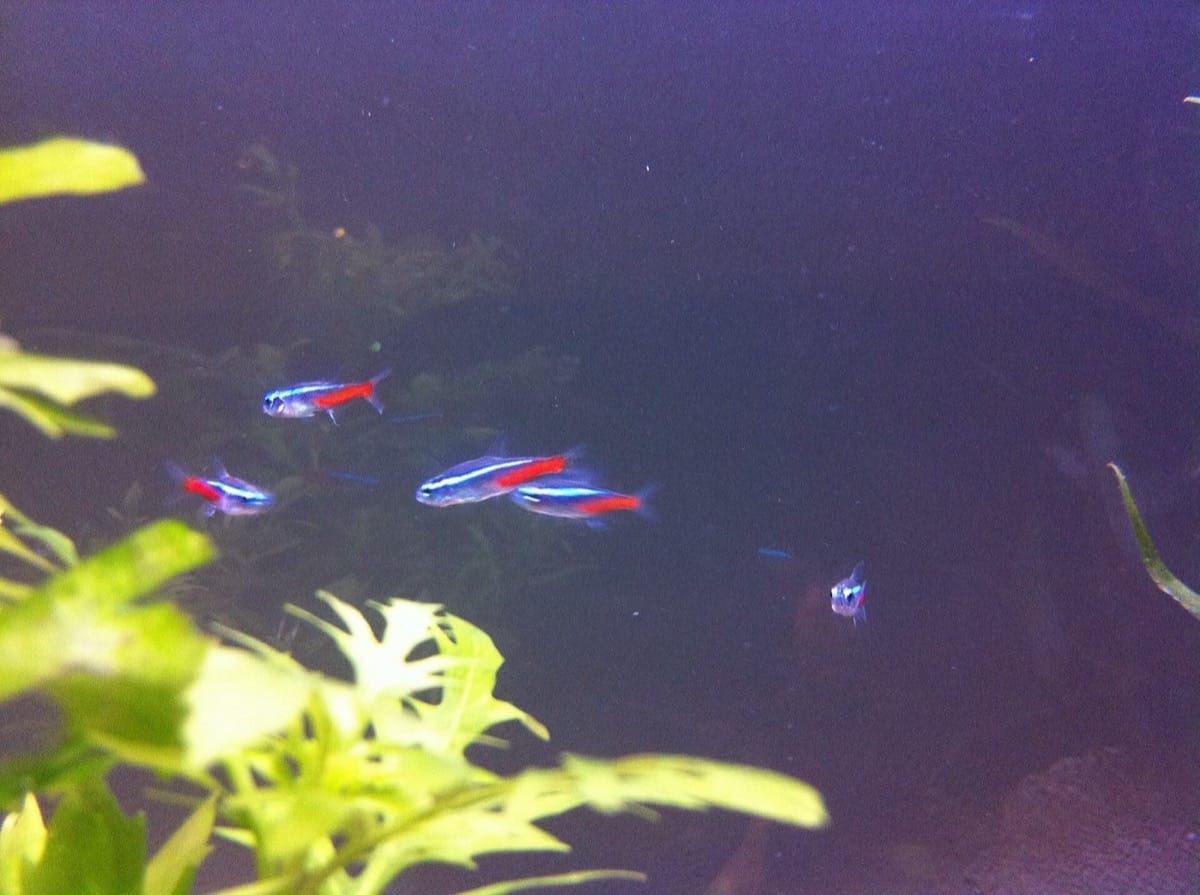
Choose a settled aquarium for a whole group of neon tetras, not a few fish to fill a gap. Their small bodies still need swimming length, modest temperatures and food that reaches the shoal.
- Temperature21-25 C
- pH6.0-7.5
- Tank planning60 L+; 60 x 30 cm base
- DifficultyIntermediate; stable group aquarium
| Stocking unit | 10 or more of this species |
|---|---|
| Food check | Fine food reaches each fish in mid-water |
| Avoid | Predatory companions and routine high-temperature setups |
Care parameters and their limits
- Temperature: 21-25 C
- SF maintenance range. Its separate, warmer breeding instructions are not everyday community-tank guidance. Seriously Fish: Paracheirodon innesi
- pH: 6.0-7.5
- Tankwise planning band for captive-bred stock within the SF 4.0-7.5 range; low-pH specialist or wild-fish systems need separate planning. Seriously Fish: Paracheirodon innesi
- General hardness: 1-12 dGH
- SF husbandry range; confirm the supplier water rather than assuming all captive-bred neons share one acclimation history. Seriously Fish: Paracheirodon innesi
- Adult size: Up to 3 cm standard length
- SF maximum standard length excludes the tail fin. Seriously Fish: Paracheirodon innesi
- Tank planning: 60 L+; 60 x 30 cm base
- SF recommends at least this footprint; 60 L is Tankwise planning headroom for the shoal, not a stocking formula or a license to add another group. Seriously Fish: Paracheirodon innesi
- Lifespan: No universal estimate supplied
- No general captive lifespan is established by the consulted species reference; the old numerical promise is not retained. Seriously Fish: Paracheirodon innesi
- Diet: Omnivore; fine prepared and small frozen foods
- SF recommends a varied menu including small invertebrates; food must actually fit the fish mouth. Seriously Fish: Paracheirodon innesi
- Social plan: 10 or more neon tetras
- Uses the upper end of the SF recommendation to buy at least 8-10. Other tetra species do not count toward this group. Seriously Fish: Paracheirodon innesi
Reserve the aquarium for the whole shoal
Plan for at least ten neon tetras together. Seriously Fish recommends a group of at least 8-10 and a 60 x 30 cm or larger base. We use ten as the planning floor and 60 L or more as an editorial volume margin. Neither number licenses adding another full shoal without reviewing the available space and filtration.
Length gives the group somewhere to move; height alone cannot replace it. Keep a continuous mid-water swimming route with planted or shaded edges to retreat into. Other small tetras may be companions, but they do not count as neon tetras when deciding whether this group is complete. Avoid placing a few neons in a small display merely because their individual body length is short.
Do not borrow a warmer fish's settings
The species reference's maintenance range is 21-25 C. Its warmer breeding section describes a different task and should not set the temperature for a permanent display. Our pH 6.0-7.5 planning band is deliberately narrower than SF's 4.0-7.5 reference range; it is not an instruction to acidify tap water toward a wild-habitat extreme. The same profile notes that commercially bred fish are more adaptable than wild specimens.
Before purchase, compare the supplier's temperature and water chemistry with your established aquarium. Check GH as well as pH. If your tank must run substantially warmer for its existing fish, reconsider the species combination instead of splitting the difference at the edge of each fish's range. A mature filter and repeatable maintenance matter more than making the water look like a blackwater photograph.
Small mouths need a visible share of the meal
Offer fine complete food and suitable small frozen invertebrates, following the varied diet described in the species profile. Watch for actual swallowing: a fish repeatedly taking and spitting a particle may need smaller food. Deliver it where the shoal feeds rather than leaving all the ration at the surface for faster companions.
Use more than one feeding position if necessary, and remove leftovers rather than increasing the entire ration to compensate for competition. Observe individuals, not just the movement of the group. If one fish cannot reach food, investigate obstruction or harassment before assuming the aquarium needs more food.
Peaceful is only one compatibility test
Choose similarly sized, non-predatory neighbours with overlapping long-term water needs. Adult angelfish can eat small tetras; growing up together is not a reliable safeguard. A matching pH number does not cancel that risk. Keep the shoal's feeding and swimming space intact when considering bottom-dwellers or another group.
When maintaining the aquarium, record water-test results and the amount of waste collected so that partial changes respond to the actual load. Do not let a routine calendar percentage override deteriorating conditions. Prepare replacement water appropriately and avoid abrupt changes in temperature or chemistry; adding fish should trigger a review of both the group layout and filter load.
A pale or isolated neon is not a diagnosis
Colour loss, white areas, wasting or leaving the group can have more than one cause. Do not label a fish with 'neon tetra disease', declare it incurable, or choose antibiotics from appearance alone. Record the pattern, appetite, breathing, water tests and recent introductions for an aquatic veterinarian or qualified fish-health professional. Merck describes why history and laboratory examination matter.
Progressive wasting or lesions need prompt advice; laboured breathing, loss of balance, rapid spread or deaths require urgent help. Check filtration and water quality while seeking help, and avoid moving fish between aquariums with shared equipment. A separate observation tank must itself have suitable, stable conditions; an unfiltered jar is not safer. Do not use blanket salt or temperature treatment. Any medicine must follow a justified diagnosis and the exact label, including sensitive companions and filtration. Stop adding improvised treatments and seek urgent advice if distress increases.
New to the words? See the aquarium glossary.
Sources and research notes
Maintenance and breeding conditions are deliberately separated. The pH band and 60 L margin are Tankwise planning choices, while the group recommendation and footprint follow the species reference. No universal lifespan is asserted.
Content reviewed 2026-10-14. Tankwise Editorial provides husbandry information, not veterinary diagnosis.
- Seriously Fish: Paracheirodon innesi
21-25 C maintenance, pH 4.0-7.5, GH 1-12 dGH, 3 cm SL, 60 x 30 cm footprint, group of at least 8-10, dim cover and varied diet. Secondary husbandry profile. Breeding temperatures are separate; its empirical medication suggestions are not used. No general lifespan is supplied. Accessed 2026-10-14.
- Seriously Fish: Pterophyllum scalare
Adult angelfish predation on small fish such as neon tetras. A compatibility exclusion, not a complete angelfish stocking plan. Accessed 2026-10-14.
- Merck Veterinary Manual: Management of Aquarium Fish
History, water-quality assessment, professional diagnostic testing and the risks of medication without a diagnosis. Veterinary reference, not a species-specific home-treatment protocol. No drug doses are reproduced here. Accessed 2026-10-14.