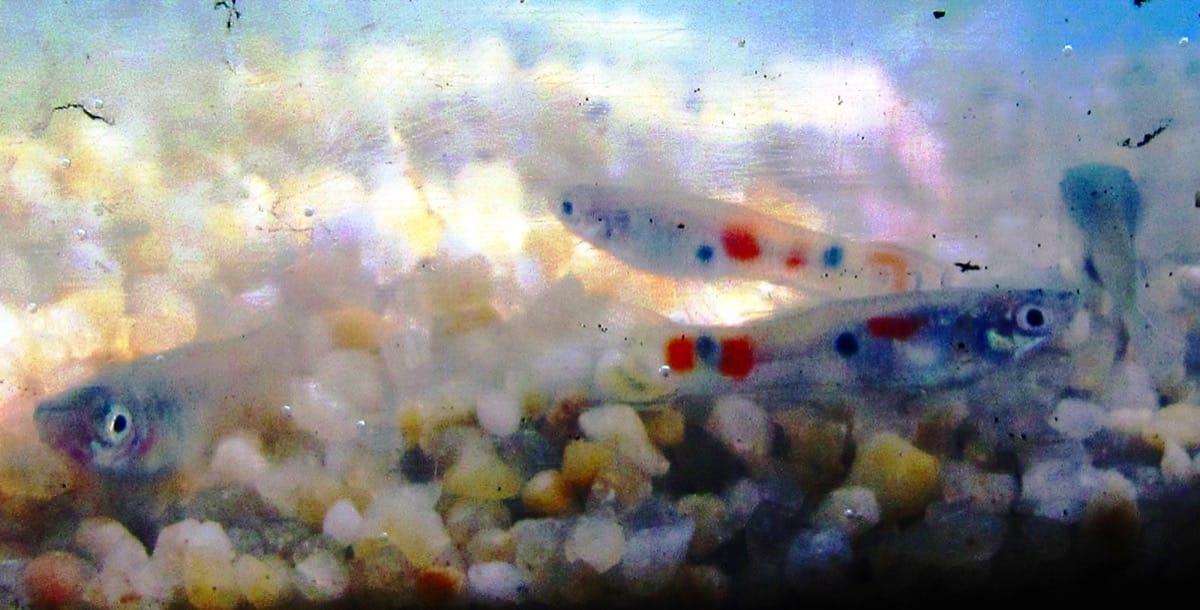
Decide whether you can accommodate offspring before buying guppies. Hard-water suitability, verified sex and feeding access are more useful checks than the promise that every fancy strain is hardy.
- Temperature22-26 C
- pH7.0-8.5
- Tank planning60 L+; 60 x 30 cm base
- DifficultyBeginner with population planning
| Before buying | Test source-water GH and pH |
|---|---|
| Population choice | Single-sex display or a managed breeding group |
| Daily check | Every fish gets food and respite from pursuit |
Care parameters and their limits
- Temperature: 22-26 C
- Tankwise routine-care planning band within the SF range of 17-28 C. Confirm the conditions used for the particular domestic strain; the lower limit is not a year-round target. Seriously Fish: Poecilia reticulata
- pH: 7.0-8.5
- SF husbandry range for a fish best maintained in moderately hard or harder water; pH alone does not measure mineral content. Seriously Fish: Poecilia reticulata
- General hardness: 8-30 dGH
- Broad SF maintenance range, not an instruction to push water to either endpoint. Ask the supplier about the strain and test the source water. Seriously Fish: Poecilia reticulata
- Adult size: Up to 6 cm standard length
- SF maximum excludes the tail; females are generally larger than males and fancy tails add space requirements. Seriously Fish: Poecilia reticulata
- Tank planning: 60 L+; 60 x 30 cm base
- Tankwise planning margin above the SF 45 x 30 x 30 cm reference aquarium, for a modest adult group with swimming space and cover. Not a capacity for an expanding breeding colony. Seriously Fish: Poecilia reticulataOATA: How to look after guppies and mollies
- Lifespan: No universal estimate supplied
- The consulted evidence does not justify one lifespan for all domestic strains. SF explicitly notes variable stock quality and premature mortality. Seriously Fish: Poecilia reticulata
- Diet: Omnivore; small prepared and invertebrate foods
- Domestic guppies accept varied aquarium foods; the wild diet is more insect-oriented and is not a complete captive feeding specification. Seriously Fish: Poecilia reticulata
- Social plan: 6 adults as a planning start; decide sex mix first
- Six is an editorial group-planning example, not an experimentally demonstrated welfare minimum. SF advises several females per male or a single-sex group; neither eliminates monitoring needs. Seriously Fish: Poecilia reticulata
The first stocking decision is about offspring
A mixed-sex purchase is a breeding decision even if breeding is not your goal. Female guppies can retain viable sperm and produce later broods without a male present. Buying only females therefore does not reliably prevent births. Seriously Fish describes sperm storage and recommends single-sex stock when fry are not wanted. Ask the seller to verify sex using the anal fin rather than colour alone.
A verified male-only group avoids births but still needs observation for chasing and uneven feeding. For a mixed group, keep several females per male, provide visual breaks, and have separate accommodation or responsible rehoming arranged before fry appear. More females spread pursuit; they do not make persistent harassment acceptable. Do not keep adding females to an already crowded tank in an attempt to fix aggression.
Match the source water before choosing a strain
Guppies are best maintained in moderately hard or harder water. The SF reference gives pH 7.0-8.5 and GH 8-30 dGH, but a broad range is not a reason to change an established fish abruptly. Measure GH as well as pH and ask about the breeder's conditions. If your water is very soft, choosing a more suitable species is simpler than continually adjusting water for a new keeper.
Our 22-26 C planning band sits within SF's wider 17-28 C range. It is a routine planning choice, not proof that all domestic strains share the same optimum. Do not infer that guppies need salt because some wild populations use brackish water; salinity is a different decision from freshwater hardness.
Budget space for adults, not today's fry count
Use 60 L or more and at least a 60 x 30 cm base as a Tankwise starting plan for a modest group. Six adults is an editorial planning example, not a tested minimum group size or a tank capacity formula. This adds room beyond SF's 45 x 30 x 30 cm reference aquarium for movement, planted refuges and sight breaks. It does not provide unlimited space for offspring.
Keep an open swimming area and gentle flow, especially for large-tailed strains. A developing fry population also increases feeding and waste. OATA advises gradual stocking, regular water testing and a mature filter; clear-looking water does not show whether the filter can process the load. Test at least weekly and after population changes, remove uneaten food, and use conditioned replacement water. A weekly 25% change is OATA's starting recommendation, not a guarantee for a breeding colony.
Long tails and quick appetites change the community
Do not combine fancy guppies with known fin-nippers or predators. Their trailing fins also make a betta an unsuitable default companion. Water compatibility must be checked for the actual neighbours, not inferred from the label 'community fish'. A soft-water specialist is not automatically a good match simply because both fish appear peaceful.
Provide appropriately sized complete flakes or pellets and small invertebrate foods for variety. Watch each guppy eat rather than adding food until the fastest fish stops begging. If another fish repeatedly misses meals, separate feeding positions or reconsider the combination; more food for the entire aquarium can simply become waste. Domestic guppies accept a broad menu, while SF describes wild fish as primarily insectivorous. This is not a reason to feed an aquarium solely on one live food.
Do not diagnose shimmying or a damaged tail by sight
Shaking, clamped fins, a ragged tail or weight loss are observations, not a diagnosis of parasites or fin rot. Review GH, pH, temperature, ammonia and nitrite, feeding access and recent introductions. OATA advises against buying from a tank containing sick fish even when the individual you want looks normal.
Seek an aquatic veterinarian or qualified fish-health professional promptly for persistent food refusal, progressive damage or weight loss; breathing difficulty, loss of balance or multiple affected fish need urgent help. Merck recommends a history and appropriate diagnostic testing. Do not use a fixed three-day waiting period, routine deworming, salt or heat as a substitute. Treatment depends on the cause and the exact product label, including other animals and filter effects. If fish deteriorate during an improvised treatment, stop adding products and obtain urgent professional advice.
New to the words? See the aquarium glossary.
Sources and research notes
SF supplies the species ranges; the narrower temperature band, six-adult example and larger aquarium are explicit Tankwise planning choices. Population growth can invalidate the initial space and maintenance plan.
Content reviewed 2026-10-14. Tankwise Editorial provides husbandry information, not veterinary diagnosis.
- Seriously Fish: Poecilia reticulata
Hard-water preference, 17-28 C, pH 7.0-8.5, GH 8-30 dGH, 6 cm SL, reference aquarium, sex differences, sperm storage and fin-nipping risks. Secondary species profile; ranges span varied stocks. Does not establish a universal lifespan, a six-fish minimum or the editorial 60 L plan. Accessed 2026-10-14.
- OATA: How to look after guppies and mollies
Mature filtration, gradual stocking, zero ammonia/nitrite at introduction, signs warranting concern, weekly tests and partial water changes. Trade-association guidance covering two groups. Only the accessible introduction and maintenance text is used; molly-specific parameters are not transferred to guppies. Accessed 2026-10-14.
- Merck Veterinary Manual: Management of Aquarium Fish
History, water-quality assessment, professional diagnostic testing and the risks of medication without a diagnosis. Veterinary reference, not a species-specific home-treatment protocol. No drug doses are reproduced here. Accessed 2026-10-14.