Why Are My Fish Dying? Common Causes and Fixes
Protect surviving fish, check water and equipment, and build a useful timeline when fish die. Avoid blind water changes or guessed disease treatments.
If fish are dying and others are gasping or losing balance, treat this as an emergency: support aeration, check the shared water and equipment, and contact an aquatic veterinarian or qualified fish-health professional now. Do not wait for another death before seeking help. The purpose of this guide is to protect survivors and narrow the investigation, not to diagnose a disease from a photograph or promise one simple fix.
Protect survivors without destroying the evidence
- Check breathing and water movement. Restore a stopped air pump or blocked flow only if it is safe to do so; use an additional air stone or increase surface movement if available. Pause injected CO2 while investigating respiratory distress. Do not put your hands in water with damaged electrical equipment; isolate power safely and get appropriate help.
- Measure, then record. Check temperature with a separate thermometer, pH, ammonia and nitrite. Record values, units, test method and time. If possible without delaying urgent support, take a separate tank-water sample before changing water or adding products.
- Stop adding uncertainty. Do not add new fish, transfer wet equipment to other tanks, turn up the heater or start a mixture of salt and medicines. Stop an ongoing suspected chemical addition. Keep the container or photograph its label and record the amount used.
- Remove dead fish and obvious uneaten food. Count and identify the losses. Ask the diagnostic service whether it needs a freshly dead specimen before discarding it. Do not strip the whole tank or sterilize its biological filter as an automatic response.
Surface gasping can result from low oxygen, nitrite exposure or gill disease; an air stone supports the fish but does not identify or remove every cause. Merck's environmental-disease guidance explains these overlapping signs, CO2 problems and water-quality interactions. If fish remain distressed after the first support measures, continue seeking urgent help rather than working through every possible diagnosis at home.
Let the measurements change the response
A partial water change can dilute some hazards, but only if the replacement water is safer and compatible. Prepare water with a conditioner suitable for the supply's chlorine or chloramine, following the exact label. Check its temperature and chemistry against the aquarium. The amount and pace of replacement depend on the readings, suspected contaminant and differences between the two waters; no fixed percentage fits every emergency.
| Finding or recent event | Useful action | Important limit |
|---|---|---|
| Detectable ammonia or nitrite, especially after filter disruption or increased stocking | Check the source water, restore safe filter flow and aeration, and use compatible treated replacement water to reduce exposure. Re-test after intervention and record the result. | A result warrants investigation but does not prove it caused the death. Ammonia interpretation also needs pH, temperature and the type of test. |
| Very low pH with accumulated ammonia in a neglected tank | Get urgent advice on a controlled correction or suitable holding-system plan before abruptly changing chemistry. | A large change with higher-pH water or a pH-raising chemical can make the existing ammonia more toxic. |
| Distress during or soon after a water change | Check the water source, conditioner label and amount, actual replacement volume, temperature and pH. Test free and total chlorine where possible. | Do not keep replacing water from the same suspect source without resolving its safety. A later negative chlorine test cannot exclude an earlier exposure. |
| Temperature outside the species' needs, or heater/pump failure | Stop a malfunctioning device safely and arrange a controlled return to suitable conditions while maintaining aeration. | A sudden temperature swing is not a treatment. Do not use hot water or ice as an uncontrolled correction. |
| Routine water readings appear normal but deaths continue | Request examination and additional testing directed by the history, such as dissolved oxygen, chlorine, metals or other suspected contaminants. | A standard test panel does not measure every hazard or rule out infection. |
UF/IFAS explains total ammonia, the influence of pH and temperature, and interference between some tests and conditioners. Keep the test and product names with the readings. Do not assume that a result after a water change describes the water the fish encountered earlier, or that a current normal result excludes damage from an earlier event.
The low-pH exception is particularly important: Merck describes old tank syndrome, where abrupt pH correction can increase ammonia toxicity. This is not a reason to leave dying fish untreated; it is a reason to obtain a safe correction plan instead of following a universal large-water-change instruction.
If ammonia is elevated, reduce the food load and remove leftovers while the filter problem is addressed. A temporary feeding adjustment may help, but fry and nutritionally vulnerable fish need a specific plan; do not impose a multi-day fast on every resident. UF/IFAS explicitly qualifies feed withdrawal for fry. A starving fish still produces ammonia, so fasting does not replace water management.
Use the pattern as a clue, not a verdict
Write down when the first abnormal behavior occurred, when each fish died and which species remain unaffected. Add the preceding events: livestock arrivals, feeding changes, filter cleaning, a power outage, maintenance, room sprays or cleaning chemicals, and any salt, medicine or water conditioner. Record facts even when they seem unrelated.
UF/IFAS uses mortality patterns to guide diagnostic investigation. Many fish declining together after an intervention makes a shared exposure important to investigate. Losses building over several days may suggest an infectious process; slow losses can also involve nutrition, chronic toxins or disease. These patterns overlap, and environmental injury and infection can coexist.
One death is not proof of old age or transport weakness. Check the remaining fish, including those that hide or miss meals, and look for observed chasing, injuries or feeding exclusion. Conversely, a recent addition is not proof that the newcomer brought a pathogen: the addition also changes stocking and may coincide with other events.
Describe visible findings without assigning a diagnosis. White spots, a dusty sheen or swelling can guide further assessment; our ich, velvet and dropsy guides explain their limits. Do not choose an antibiotic or antiparasitic from a symptom list. Any recommended treatment must fit the diagnosed problem, fish species, water conditions and other residents, including plants, shrimp and snails, and follow its specific label.
Send a useful case history, not just "the water is fine"
Contact a veterinary practice, aquatic diagnostic laboratory or qualified fish-health service. Ask whether it accepts pet-fish cases, how urgently it can respond, and what samples it needs. Have these details ready:
- Species and numbers kept, affected and dead; tank size, age, filtration and water source.
- Actual test readings before and after interventions, including temperature, pH, ammonia and nitrite.
- A dated event-and-death timeline, photographs or video, and observed breathing and feeding changes.
- Exact product names, concentrations, amounts and times already used, plus any response or sudden worsening.
Follow the receiving service's collection and transport instructions. A separate water sample is more informative than water from the fish's transport bag, whose chemistry changes in transit. Freshly dead fish may have diagnostic value if kept chilled, not frozen, as directed; do not chill a live fish or attempt a home dissection. UF/IFAS explains how handling affects diagnostic usefulness.
If distress starts during a treatment, stop further additions, maintain aeration and seek urgent guidance on the label's removal or adverse-reaction procedure. Do not add a second chemical to reverse an unknown reaction. Keep recording outcomes after correction: a temporary improvement does not establish the cause, and further deaths need reassessment before restocking.
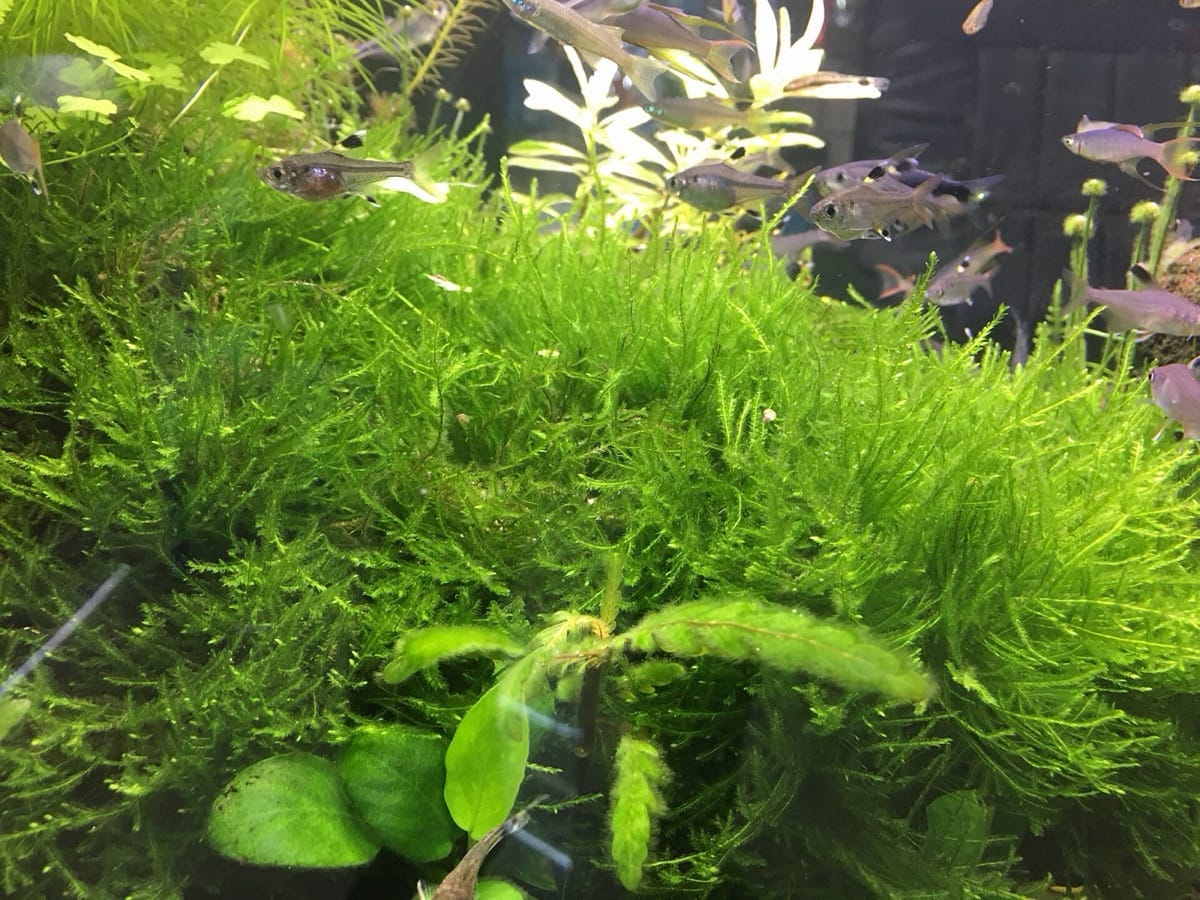
The cover is a planted community aquarium, not evidence of a particular cause of death. Tankwise Editorial provides researched information rather than veterinary care. Our editorial scope.