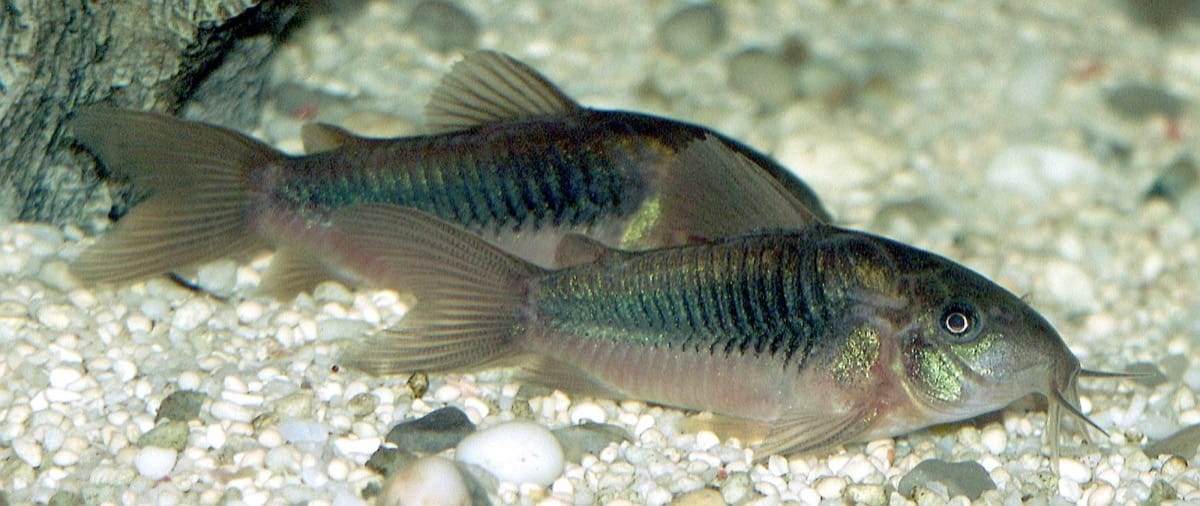
A bronze cory group needs its own floor space and meals. Buy them because you want to keep a group of catfish, not because food is accumulating under the other fish.
- Temperature21-27 C
- pH6.0-8.0
- Tank planning80 L+; 80 x 30 cm base
- DifficultyBeginner with a planned bottom-dwelling group
| Count the group | 6 or more bronze corys, not a mixed collection of single corys |
|---|---|
| Reserve the floor | Open feeding areas between sheltered resting places |
| Verify the meal | Sinking food reaches the corys before other fish take it |
Care parameters and their limits
- Temperature: 21-27 C
- SF routine husbandry range for fish traded as bronze corys; not a breeding temperature-change procedure or a range for every cory species. Seriously Fish: Osteogaster aenea (formerly Corydoras aeneus)
- pH: 6.0-8.0
- Broad SF maintenance reference. Confirm the supplier conditions rather than moving an established fish to a different endpoint. Seriously Fish: Osteogaster aenea (formerly Corydoras aeneus)
- General hardness: 2-15 dGH
- SF reference; the identity and history of commercially farmed stocks limit any universal claim of an optimum. Seriously Fish: Osteogaster aenea (formerly Corydoras aeneus)
- Adult size: Up to 7.5 cm standard length
- SF gives 75 mm SL, excluding the tail. Females tend to grow larger and broader than males. Seriously Fish: Osteogaster aenea (formerly Corydoras aeneus)
- Tank planning: 80 L+; 80 x 30 cm base
- SF recommends an 80 x 30 cm footprint for long-term care; 80 L is Tankwise planning headroom rather than a proven minimum. Available bottom area matters more than adding height. Seriously Fish: Osteogaster aenea (formerly Corydoras aeneus)
- Lifespan: No universal estimate supplied
- Fishkeeper calls them long-lived but supplies no numerical expectation in its accessible text; the consulted evidence does not establish a general captive lifespan. Seriously Fish: Osteogaster aenea (formerly Corydoras aeneus)Fishkeeper: Bronze cory - Osteogaster aenea
- Diet: Omnivore; sinking food plus small invertebrates
- SF describes foraging omnivores that need a varied, deliberately supplied diet rather than leftovers from other fish. Seriously Fish: Osteogaster aenea (formerly Corydoras aeneus)
- Social plan: 6 or more bronze corys
- Uses the upper end of the SF recommendation of at least 4-6; Fishkeeper also recommends groups. This is husbandry advice, not an experimentally proven threshold. Seriously Fish: Osteogaster aenea (formerly Corydoras aeneus)Fishkeeper: Bronze cory - Osteogaster aenea
Start with a group, then draw the floor plan
Plan for six or more bronze corys. Seriously Fish recommends at least 4-6; we use six as the starting point. This is a husbandry recommendation, not an experimentally established threshold. A panda cory or peppered cory is a different species, not a substitute when completing this group.
The reference footprint is at least 80 x 30 cm for long-term care. Tankwise pairs that with an 80 L or larger starting plan; the litre figure is editorial headroom rather than a research-derived minimum. Height cannot replace a missing length of floor. Before stocking, look at the bottom area left after rocks, plant pots and wood are installed, and allow for any other bottom-feeding fish using the same ground.
Leave connected open patches for foraging with sheltered places nearby. The species profile favours fine sand and allows clean, rounded gravel. Sand does not clean itself: remove uneaten food and accumulated waste, especially under feeding spots and around decor. Keep an unobstructed route to the surface, since these catfish also take air there.
A sinking pellet is only useful if they get it
Bronze corys are foraging omnivores, not aquarium waste processors. Provide a suitable complete sinking food and small frozen invertebrates for variety. SF explicitly warns against expecting them to survive on leftovers. Their searching movements do not demonstrate that they have found enough to eat.
Watch a whole feeding session. Do the pellets reach the bottom? Can each cory reach them? Do other fish return to take the sinking portion after finishing their own meal? Place small portions in more than one accessible spot if necessary, and observe actual feeding before increasing the total ration. There is no universal tablet count: products and fish sizes differ. If the group still cannot feed without interference, change the companion or feeding arrangement rather than leaving excess food overnight.
Match the particular cory, not the generic label
The bronze-cory reference gives 21-27 C, pH 6.0-8.0 and GH 2-15 dGH. These are broad maintenance ranges, not instructions to swing between endpoints or settings for every fish sold as a cory. Ask about the supplier's water and check your own source water before purchase. A maximum reported standard length of 7.5 cm also makes this a different space decision from keeping a tiny catfish; standard length excludes the tail.
Choose peaceful companions that share suitable long-term conditions and leave the corys access to food and cover. Avoid fish large enough to swallow them or territorial fish that repeatedly drive them from the bottom. Occupying a different swimming level does not eliminate competition at meals. Their peaceful behaviour is not a reason to add a group to an already fully stocked aquarium.
Why the same bronze cory has two scientific names
You may see Corydoras aeneus on an older label and Osteogaster aenea in newer references. SF explains the move to Osteogaster in 2024, and Fishkeeper uses the newer combination. The familiar name remains useful when comparing shop labels, but it should not be used to collapse every similar-looking catfish into one species.
SF also cautions that the broad historical range and commercially farmed stocks leave identity questions. For an ordinary domestic purchase, confirm what the seller is supplying and its care history; for a wild or locality-labelled fish, seek a more specific identification before applying this general profile. Colour alone is not enough to establish that two shop fish belong in the same group.
Separate normal air-taking from a change in breathing
An occasional quick trip to gulp air is normal for bronze corys, as described in the species reference. A sudden increase together with rapid gill movement, weakness or several affected fish is different: check filtration, aeration, temperature, ammonia and nitrite while seeking urgent professional help. Air-breathing ability does not make poor water conditions safe.
Worn barbels, red areas or trouble feeding also need assessment; their appearance alone cannot tell you whether abrasion, infection or another problem is responsible. Review substrate condition and food access, document changes and contact an aquatic veterinarian or qualified fish-health professional promptly for progressive damage or food refusal. Merck explains the role of history and diagnostic testing. Do not wait several days for erosion to worsen or assume that changing gravel is a complete treatment. Do not use routine salt, heat or a generic half-dose of medicine for catfish. Treatment must match the diagnosis and exact product label, including other animals, plants and the biofilter; stop adding improvised products and seek urgent advice if distress increases.
New to the words? See the aquarium glossary.
Sources and research notes
The group size uses the upper end of the species recommendation; the 80 L volume is Tankwise planning headroom alongside a sourced footprint. The familiar and newer scientific names are explained without claiming all traded stocks are taxonomically identical. No universal lifespan is supplied.
Content reviewed 2026-10-14. Tankwise Editorial provides husbandry information, not veterinary diagnosis.
- Seriously Fish: Osteogaster aenea (formerly Corydoras aeneus)
21-27 C, pH 6-8, GH 2-15 dGH, 7.5 cm SL, 80 x 30 cm footprint, group of at least 4-6, feeding rather than leftovers, substrate, air breathing and changed genus. Secondary husbandry profile; commercial-stock identity is qualified. Its breeding water changes and egg treatments are not used. No general lifespan supplied; the primary taxonomic paper could not be accessed for this draft. Accessed 2026-10-14.
- Fishkeeper: Bronze cory - Osteogaster aenea
Group housing, a large sandy aquarium and use of the newer scientific name. Commercial retailer; only its accessible introduction is used. Long-lived is not converted into a numerical lifespan. Accessed 2026-10-14.
- Merck Veterinary Manual: Management of Aquarium Fish
History, water-quality assessment, professional diagnostic testing and the risks of medication without a diagnosis. Veterinary reference, not a species-specific home-treatment protocol. No drug doses are reproduced here. Accessed 2026-10-14.