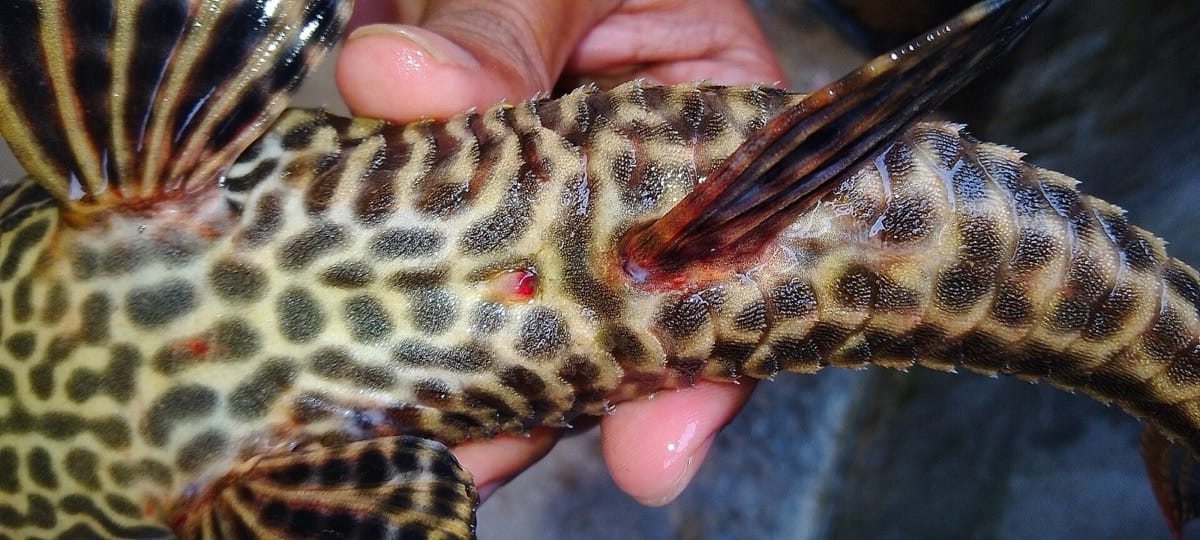
Common pleco is a trade name, not reliable species identification. Find out which fish is being sold before choosing its adult aquarium: a small algae grazer may become a large catfish that needs its own feeding space, shelter and long-term home.
- TemperatureSpecies-dependent; confirm identity first
- pHNo universal range for the trade name
- Tank planning180 x 75 cm base or larger for a large P. pardalis; editorial plan
- DifficultyAdvanced
| Buying decision | Ask for an identification and the adult housing plan |
|---|---|
| Feeding check | Confirm the pleco reaches its own sinking meal |
| If space is insufficient | Arrange suitable rehoming; never release it outdoors |
Care parameters and their limits
- Temperature: Species-dependent; confirm identity first
- Fishkeeper lists 20-30 C for Pterygoplichthys pardalis. FishBase lists 20-28 C for Hypostomus plecostomus in its environmental summary. These are different species and source contexts, not a combined target for every fish sold as common pleco. Fishkeeper: Common plec - Pterygoplichthys pardalisFishBase: Hypostomus plecostomus species summaryUSGS Nonindigenous Aquatic Species: Hypostomus plecostomus
- pH: No universal range for the trade name
- FishBase records 6.2-8.2 for H. plecostomus; that environmental range is not transferred to an unidentified Pterygoplichthys. Confirm identification and supplier water rather than chemically adjusting to a generic pleco chart. FishBase: Hypostomus plecostomus species summaryUSGS Nonindigenous Aquatic Species: Hypostomus plecostomus
- General hardness: Confirm species-specific GH; no universal value
- FishBase lists an unknown lower dH bound and an upper value of 28 for H. plecostomus. An incomplete environmental range cannot justify a captive target or a numeric lower bound for mixed trade stock. FishBase: Hypostomus plecostomus species summaryUSGS Nonindigenous Aquatic Species: Hypostomus plecostomus
- Adult size: P. pardalis: up to about 50 cm; other identities differ
- Fishkeeper maximum size for P. pardalis, without a stated measurement convention. FishBase reports 25 cm standard length for true H. plecostomus; it must not be used to downsize the plan for unidentified stock. Fishkeeper: Common plec - Pterygoplichthys pardalisFishBase: Hypostomus plecostomus species summaryUSGS Nonindigenous Aquatic Species: Hypostomus plecostomus
- Tank planning: 180 x 75 cm base or larger for a large P. pardalis; editorial plan
- Editorial turning-space example for a fish approaching 50 cm, based on Fishkeeper warning that it outgrows ordinary communities. Not an experimentally established minimum or a universal plan for all plecos. Depth, decor, water volume and maintenance capacity require separate assessment. Fishkeeper: Common plec - Pterygoplichthys pardalisUSGS Nonindigenous Aquatic Species: Hypostomus plecostomus
- Lifespan: No universal captive lifespan stated
- Fishkeeper calls P. pardalis long-lived but does not establish a survival interval. Neither that description nor FishBase population models justify a common-pleco lifespan figure. Fishkeeper: Common plec - Pterygoplichthys pardalisFishBase: Hypostomus plecostomus species summary
- Diet: P. pardalis: plant-rich omnivore; dedicated sinking food
- Fishkeeper describes an omnivore whose diet should be largely vegetable matter and lists catfish pellets, wafers and frozen foods. Identify other plecos before transferring this menu. Fishkeeper: Common plec - Pterygoplichthys pardalis
- Social planning: One large pleco as the starting plan
- Editorial lower-conflict plan based on Fishkeeper reports of disputes when several share an aquarium. This is not a requirement to buy a group or a guarantee of safety with other species. Fishkeeper: Common plec - Pterygoplichthys pardalis
Resolve the name before trusting the numbers
A sales label reading Hypostomus plecostomus does not prove that identification. The USGS species profile documents confusion between Hypostomus and Pterygoplichthys, including historical records assigned to the wrong genus. A practical trade example is Fishkeeper's Common Plec profile, which identifies its fish as Pterygoplichthys pardalis, not H. plecostomus.
Those names are not interchangeable. Fishkeeper gives P. pardalis a maximum size of 50 cm. FishBase reports 25 cm standard length for true H. plecostomus; standard length excludes the tail fin. Neither number identifies a juvenile at the shop. Ask for the supplier identification and clear photographs for assessment by a knowledgeable catfish specialist. If identification remains uncertain, do not buy on the assumption that you have the smaller species.
The parameter panel therefore keeps species boundaries visible. Published temperature ranges differ: Fishkeeper lists 20-30 C for P. pardalis, while FishBase lists 20-28 C for H. plecostomus. FishBase's pH and incomplete hardness records are not universal husbandry instructions for the trade name. Confirm the species and current holding water before planning conditions; if you already own the fish, do not abruptly change its water to match another species' chart while identification is pending.
Measure the adult home, including the route to its shelter
For a large P. pardalis, an aquarium with a base of 180 x 75 cm or larger is our editorial planning example, not a proven minimum. It makes room for a fish approaching the 50 cm size described by Fishkeeper, with usable turning space after the shelter and other decor are installed. That source's four-foot tank is explicitly a starting home before an upgrade, not an adult endpoint.
A 180 x 75 x 60 cm rectangular box holds a calculated 810 litres before glass, the air gap, substrate and decor are accounted for. This is a scale illustration, not a safe stocking capacity or medication volume. A narrower, taller tank with similar litres may still fail the turning-space check. The shelter entrance must remain usable as the fish grows, and heavy decor must be stable: large specimens can dislodge it.
Also check whether you can service that aquarium. Leave access to siphon waste behind the shelter, maintain mechanical and biological filtration, and perform water changes appropriate to measured water quality. Test rather than assuming clear water is clean. A larger filter is useful for waste processing but does not replace floor space, maintenance access or an adult-sized refuge.
Give the pleco its own meal and territory
Fishkeeper describes P. pardalis as an omnivore with a predominantly vegetable diet. Use suitable sinking catfish food as a planned meal, with appropriate vegetable variety, rather than expecting algae, wood or other fishes' leftovers to provide complete nutrition. Follow the prepared food's guidance and adjust to actual intake. Place food where the fish can reach it without competing at the surface.
If it will not emerge during the busiest feeding period, offer its portion when the aquarium is quieter and confirm that it eats. Other bottom feeders can take a wafer before the pleco reaches it; a large pleco can also exclude them. Remove leftovers and inspect the animal's condition rather than assuming a hidden fish must be finding food.
Start with one large pleco, not a pair of cleaners. Fishkeeper reports disputes when several share a tank. Any community needs separate shelters and feeding access, compatible water conditions and enough space for every adult, not merely fish too large to be swallowed. Watch for pursuit, fin damage and exclusion from shelters or meals. If these persist, separate into suitable accommodation rather than trying to solve territorial competition by adding more food.
If the adult plan does not fit, change the purchase
Before buying, ask what the shop can actually confirm about identity and adult size. Research a smaller, positively identified species as a separate choice if the large-fish setup is not realistic; it will still need deliberate feeding and suitable space. Do not buy a common pleco to solve an algae problem that needs a maintenance or lighting review.
If the fish is already outgrowing its home, contact an experienced retailer, aquarium society or rescue and confirm that the recipient has appropriate space before arranging a transfer. Do not assume a public aquarium can accept it. Never release it into a river, lake or drainage system: USGS records aquarium release as an introduction pathway. An outdoor pond is not an automatic answer either; climate, containment and local rules must suit the identified species.
A thin belly or skin patch does not identify the cause
Weight loss, a sunken abdomen, reduced feeding, damaged skin or unusual breathing need investigation, not a default dewormer or a guess that the fish only needs more algae. The Merck Veterinary Manual recommends a husbandry history, water assessment and diagnostic examination before targeted treatment. External appearance cannot reliably distinguish nutritional, environmental and infectious causes.
Record the best available identification, actual food intake, water tests, temperature, recent additions and any chemicals used. Check that food and shelter are accessible, but do not wait through a feeding experiment if the fish is losing condition or has progressing lesions. Contact an aquatic veterinarian or qualified fish-health professional promptly; severe breathing distress, loss of balance, major injury or rapid deterioration is urgent.
Do not use salt, heat or a general antibacterial remedy as a diagnostic trial, and do not assume that a catfish needs a universal half dose. Treatment depends on the diagnosis, identified animal, exact product label, actual water volume and other inhabitants. Stop improvised treatment if distress increases and obtain professional advice rather than combining more products.
New to the words? See the aquarium glossary.
Sources and research notes
Common pleco is not treated as one reliably identified species. P. pardalis is the explicit large-trade-fish example; H. plecostomus data remain separately labelled. Unknown identity is not resolved by combining water ranges or inventing a universal lifespan.
Content reviewed 2026-10-14. Tankwise Editorial provides husbandry information, not veterinary diagnosis.
- USGS Nonindigenous Aquatic Species: Hypostomus plecostomus
Identification difficulty, historical confusion with Pterygoplichthys, aquarium release and non-native occurrence. Invasion database, not an aquarium stocking standard or a global survey of retail identifications. Narrative revision is dated 2013, with occurrence data updated separately. Accessed 2026-10-14.
- FishBase: Hypostomus plecostomus species summary
True species identity, reference-linked 25 cm standard length, environmental temperature/pH records and incomplete hardness record. A species database with mixed reference dates, not proof of optimum captive conditions. Its incomplete dH range and population-model outputs are not converted into GH targets or lifespan. Accessed 2026-10-14.
- Fishkeeper: Common plec - Pterygoplichthys pardalis
A named species sold as common plec, maximum size, temperature range, adult-space warning, food, decor disturbance and disputes between specimens. Commercial specialist husbandry advice. No numerical adult minimum or reliable lifespan interval is supplied. The 180 x 75 cm base is an editorial example, not the source recommendation; its absolute tank-mate safety claim is not adopted. Accessed 2026-10-14.
- Merck Veterinary Manual: Management of aquarium fish
Clinical history, diagnostic examination, water assessment and targeted rather than undiagnosed medication. General fish-health principles, not a diagnosis or a drug protocol for an unidentified pleco. No doses are reproduced. Accessed 2026-10-14.