Aquarium Salt: When to Use It (and When Not To)
Decide when aquarium salt has a specific use, check species and treatment limits, and avoid accumulating salt through repeated doses or top-ups.
Use aquarium salt for a defined purpose, not simply because a fish looks unwell. Sodium chloride has legitimate uses in freshwater fish medicine, but the right exposure depends on the problem, species and treatment system. If fish are gasping, losing balance or dying, support aeration and seek urgent aquatic veterinary or qualified fish-health help; do not try a salt dose as a diagnostic test. Start with the aquarium emergency investigation.
This guide helps you decide whether salt belongs in a plan and avoid accidental accumulation. It does not supply a universal spoonful, dip recipe or treatment temperature. Merck describes salt's medical uses alongside species-dependent exposure and targeted treatment, not a single remedy for every symptom.
Name the job before opening the container
- A confirmed external parasite
- Salt may be an option for some parasites if the fish and system tolerate the required exposure. White spots or rubbing alone cannot identify the parasite. For ich, treatment must account for protected stages and susceptible free-swimming stages; a quick dip does not establish that the original tank is clear. UF/IFAS explains these limits and species-specific salt tolerance. Use the ich guide for that disease's diagnostic and treatment boundaries, rather than combining heat and salt automatically.
- Osmoregulatory support
- Freshwater fish regulate the movement of water and ions across their body surfaces. Skin or gill injury can disrupt that balance. A professional may use salt to reduce that burden in selected cases, as described by Merck's physiology and treatment guidance. Support is not proof that an infection has been treated or that an injured fish needs a concentrated dip.
- Measured nitrite exposure
- Chloride can compete with nitrite uptake at the gills. This can reduce exposure, but does not remove nitrite from the water or repair a failed biofilter. Merck recommends addressing water quality and the underlying filtration problem. A professional needs the nitrite reading and units, existing chloride and species before choosing a chloride plan. Do not copy a production-pond ratio into a mixed aquarium.
- Routine prevention or an unexplained symptom
- A new fish, a torn fin, swelling or abnormal swimming is not by itself an indication to add salt. Investigate the cause. Salt cannot replace diagnosis, appropriate water management or treatment of an internal infection. Do not let a trial delay help for a deteriorating fish.
Check what the product actually contains
Here, aquarium salt means a sodium-chloride product. Read its ingredient list rather than treating every product called a salt as interchangeable. Epsom salt is a different substance, and marine salt mixes contain a mixture of ions intended to prepare marine water. Neither is a spoon-for-spoon substitute for a sodium-chloride treatment.
Sodium chloride also is not a general-hardness or buffering supplement: it does not supply the calcium and magnesium measured by GH or the carbonate buffering commonly measured by KH. Merck distinguishes hardness, alkalinity and salinity, and explains why marine water requires a complex salt mixture. A fish needing harder freshwater does not therefore need aquarium salt.
Use a product whose composition and relevant instructions can be verified. A manufacturer's directions apply to that product; broad claims about tonic benefits do not establish that your fish needs it. Do not substitute an unidentified household salt or combine a salt product with medicines just because an online recipe does so.
Conditions a treatment plan must settle
- Species and life stage: confirm tolerance for every exposed animal, not just the sick fish. Broad labels such as "scaleless" or "catfish" do not establish a safe concentration. If compatibility is uncertain, do not improvise a half dose.
- Location: check plants, shrimp, snails and any other residents before treating a display. UF/IFAS warns that plants may not tolerate therapeutic salinity. Unknown compatibility is a reason to choose another plan, not experiment on the community. A separate system still needs appropriate space, aeration, temperature control and water-quality monitoring.
- Water and previous products: record temperature, pH, ammonia, nitrite, existing salt exposure and all medicines or conditioners. Keep temperature appropriate to the species; extra heat is not a default partner for salt. Confirm any proposed combination with the product instructions and treating professional.
- Concentration and duration: a short dip and a prolonged bath are different exposures. Follow the exact applicable label and clinician's plan for preparation, actual water volume, units, observation and completion. Do not lengthen a dip into an overnight bath or turn a long-bath concentration into a stronger quick treatment.
- Monitoring and exit: agree how the intended salinity will be checked, how water changes affect it, when the fish will be reviewed, and how to end treatment safely. Use a measurement method suitable for the intended range. Do not treat a general TDS reading as a measurement of sodium chloride alone.
If these conditions cannot be established, pause the salt treatment and ask for an alternative. This is especially important when the initial salt concentration is unknown. The veterinary guidance distinguishes exposure types and cautions about unfamiliar species; its clinical examples are not universal home-aquarium recipes.
Keep a salt record, not a calendar reminder
Salt remains when water evaporates. Ordinary aquarium filtration is not a way to remove dissolved sodium chloride. API's instructions for its aquarium salt explicitly warn that it does not evaporate or filter out. That product information supports this accumulation warning; its routine-use marketing is not independent evidence that every aquarium benefits.
An evaporation top-up replaces lost water, not a lost salt dose. Removing salted water removes some salt, but a partial water change does not reset the whole aquarium to zero. Repeating an initial full-tank amount after every partial change can therefore increase exposure.
Keep this record with the treatment instructions:
| Record | Why it matters |
|---|---|
| Product, amount, units and time added | Distinguishes the actual exposure from a remembered "small spoonful." |
| Actual treatment water volume and measured salinity | The tank's advertised capacity is not necessarily its filled water volume. |
| Water removed and replacement water added | Separates water exchange from evaporation top-ups; record spills or other losses too. |
| Any salt already in replacement water | Avoids counting new water as salt-free when it is not. |
| Breathing, balance, appetite and water-test results | Lets the professional compare the fish's condition with interventions. |
Only replace salt if the agreed plan calls for maintaining that concentration, using the recorded changes and appropriate measurement. At the end of treatment, use the agreed removal schedule rather than continuing additions out of habit. If earlier amounts are unknown, do not estimate a new dose from taste, appearance or fish behavior.
When to stop and get help
Watch the fish during any supervised short dip. Rolling onto its side or other marked distress means end the dip immediately and return it to the prepared, aerated recovery water specified in the plan, with compatible temperature and pH and appropriate chlorine/chloramine treatment. Merck explicitly identifies distress as a reason to remove fish from a dip. Do not wait for the planned timer to finish.
For ongoing tank treatment, new respiratory distress, loss of balance or rapid deterioration means stop further additions, maintain aeration and seek urgent advice on reducing exposure or moving the fish safely. Do not make an uncontrolled whole-tank salinity or pH change, or add another chemical to counteract the reaction. Provide the salt record and product label. Continued illness or deaths needs reassessment of the diagnosis and environment, not a stronger salt concentration.
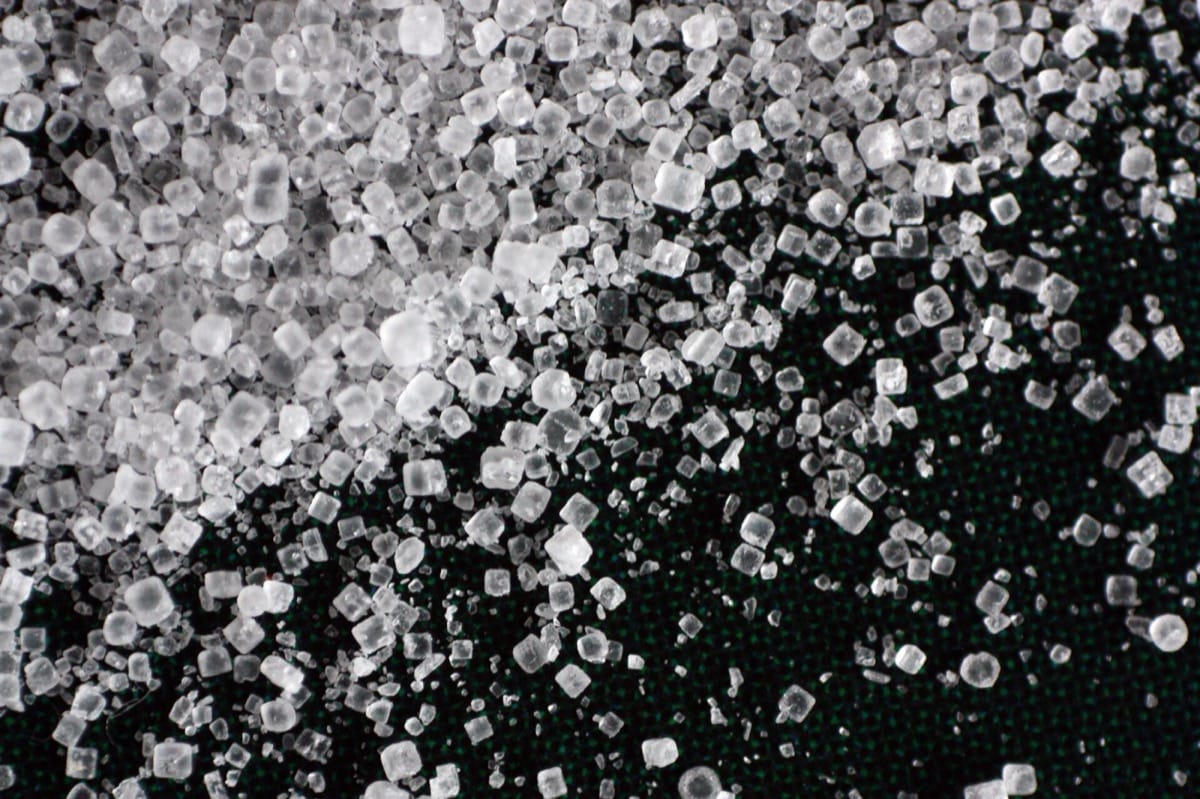
The cover shows salt crystals, not a measured dose or an endorsed product. Tankwise Editorial provides researched information, not veterinary prescribing. About our editorial scope.